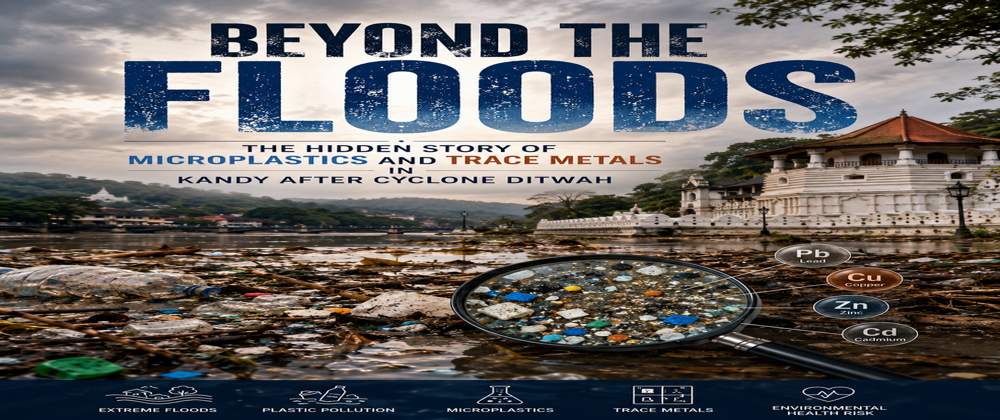
Beyond the Floods: The Hidden Story of Microplastics and Trace Metals in Kandy after Cyclone Ditwah
Material Development and Pollutant Remediation
Published on Fri, 06/12/2026 - 13:13
ditwa
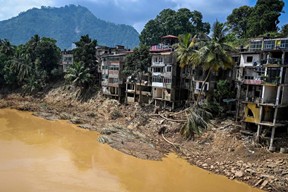
Cyclone Ditwah swept across Sri Lanka in Late November 2025, causing an estimated US$ 4.1 billion in direct damage to infrastructure, agriculture, and property, according to the World Bank’s Global Rapid Post-Disaster Damage Estimation (GRADE) report. The Central Province, particularly Kandy, experienced some of the most severe impacts due to intense rainfall and landslides. Although the physical damage was clearly visible, an equally important but less visible impact occurred beneath the surface: disruptions to water quality and the mobilization of hidden pollutants such as microplastics and trace metals in urban freshwater systems. 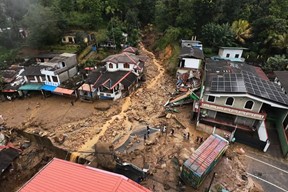
Microplastics are plastic particles smaller than 5 mm in size that originate either as primary microplastics (intentionally manufactured at microscopic sizes, such as microbeads and synthetic fibers) or as secondary microplastics formed through the fragmentation of larger plastics. Due to the widespread use of disposable plastics, especially in packaging materials like bags, bottles, and food containers, a significant proportion of plastic waste rapidly enters the environment. Over time, environmental factors such as solar radiation and physical abrasion drive their degradation into smaller particles. These microplastics are commonly classified into five categories: fibers, fragments, films, foams, and pellets. Chemically, they consist of polymer chains primarily made of carbon and hydrogen.
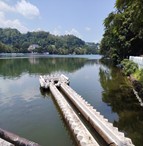
Kandy Lake, an ancient and iconic freshwater body located at the center of Kandy city and historically known as “Kiri Muhuda,” covers approximately 0.25 km2, with a circumference of about 3.2 km and a maximum depth of around 18.5 m. The Mid Canal (Meda Ela), which originates as the outlet of Kandy Lake, flows through highly urbanized areas for approximately 6 - 8 km before discharging into the Mahaweli River at Gatambe. This study conducted a comparative assessment of these interconnected systems before and after Cyclone Ditwah (October–December 2025).
Sampling was carried out at seven locations in Kandy Lake (including six inlets and one outlet), seven locations along the Mid Canal (covering upstream, midstream, and downstream), and one reference site at the Mahaweli River, Gatambe. Bulk water samples (5 L) were collected from each site and processed using standard microplastic extraction techniques, including organic matter digestion with Fenton’s reagent (Fe2+ and H2O2), density separation using NaCl, vacuum filtration, and visual identification under a fluorescence microscope. Polymer types were confirmed using FTIR and Raman spectroscopy. Water quality parameters were analyzed following APHA standard methods.
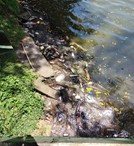
Results revealed a marked increase in microplastic abundance in Kandy Lake, rising from 5.77 ± 2.21 items/L before the cyclone to 16.17 ± 4.87 items/L afterward. In contrast, the Mid Canal showed a decrease from 15.11 ± 4.28 items/L to 8.94±4.90 items/L, while the Mahaweli River exhibited an increase from 7.4 to 15.6 items/L. The elevated levels in Kandy Lake can be attributed to intense surface runoff, sediment resuspension, and pollutant inflow during the cyclone. Conversely, the reduction observed in the Mid Canal is likely due to its high flushing rate, which facilitates the downstream transport of microplastics.
Spatial patterns further indicated that the highest microplastic concentrations in Kandy Lake occurred near its outlet, which feeds directly into the Mid Canal. Correspondingly, higher levels were observed in the upper canal immediately after the outlet, followed by a gradual decline downstream due to variations in flow rate, channel morphology, and elevation.
Polymer analysis identified polyethylene (PE), polypropylene (PP), nylon (PA), and polystyrene (PS) as the dominant types, indicating strong contributions from consumer packaging waste. Most particles were smaller than in between 100 µm, with fibers being the most abundant form, followed by pellets. Spectroscopic analysis confirmed a high proportion of fibers (approximately 75%).
Trace metal analysis showed a substantial increase in concentrations of manganese (Mn), iron (Fe), and zinc (Zn) in Kandy Lake after the cyclone, which may be mostly driven by runoff and sediment disturbance. Similar trends were observed in the Mid Canal, although Fe showed only slight increases in some locations. In contrast, toxic metals such as cadmium (Cd) and lead (Pb) decreased significantly after the cyclone in both systems, likely due to dilution and flushing effects. In the Mid Canal, Cd concentrations dropped from previously high levels (up to 48 ppm) to below 1 ppm, while Pb and cobalt (Co) were recorded in downstream locations, further proving the role of hydrodynamic mobilization.
Spearman correlation analysis revealed statistically significant relationships (p<0.05) between microplastic abundance and trace metals. Strong positive correlations with manganese (r = 0.867) and copper (r = 0.760) suggest that microplastics may act as vectors for metal adsorption, enhancing their mobility and potential bioavailability in aquatic environments.
Water quality parameters exhibited site-specific changes. In Kandy Lake, pH shifted toward more alkaline conditions (from 6.64 -7.81 to 7.37 - 8.21), likely due to mineral -rich runoff, and mixing may reduce the dissolved CO2 levels. In contrast, the Mid Canal showed greater variability (6.12–7.60), with lower values observed at the Mahaweli River, indicating dilution and organic matter input after the cyclone to the flowing systems. Dissolved oxygen (DO) levels increased slightly in both systems, while biological oxygen demand (BOD) showed variable responses, reflecting changes in organic pollution load.
Cyclone Ditwah indicated three contrasting system responses, including the Kandy Lake showed pollutant accumulation driven by runoff and sediment resuspension, the Mid Canal acted mainly as a flushing and transport pathway, reducing in-system retention; and the Mahaweli River functioned as a downstream receptor receiving redistributed contaminants, indicating the need for mitigation and management approaches.
Effective environmental management should begin with efficient waste segregation at source, systematic waste collection, and stricter enforcement of regulations on single-use plastics, alongside the promotion of environmentally friendly alternatives to reduce plastic dependency. In parallel, climate-resilient urban planning should be integrated, including the use of permeable surfaces, green infrastructure, and urban buffer zones to minimize surface runoff and pollutant transport. Finally, long - term sustainability depends on strong public awareness and stakeholder engagement, where educational programs, community participation, and coordinated action among policymakers, researchers, and local authorities collectively support effective implementation of mitigation measures and enhance the resilience of urban water systems against climate - driven pollution.
Project: Material Development and Pollutant Remediation
Team leader: Dr I.P.L. Jayarathna
Team members:
J.M.S.G.B. Navarathne
Tharushi Meegahakumbura
Meanu Hasara
Kushlani madhumekala